

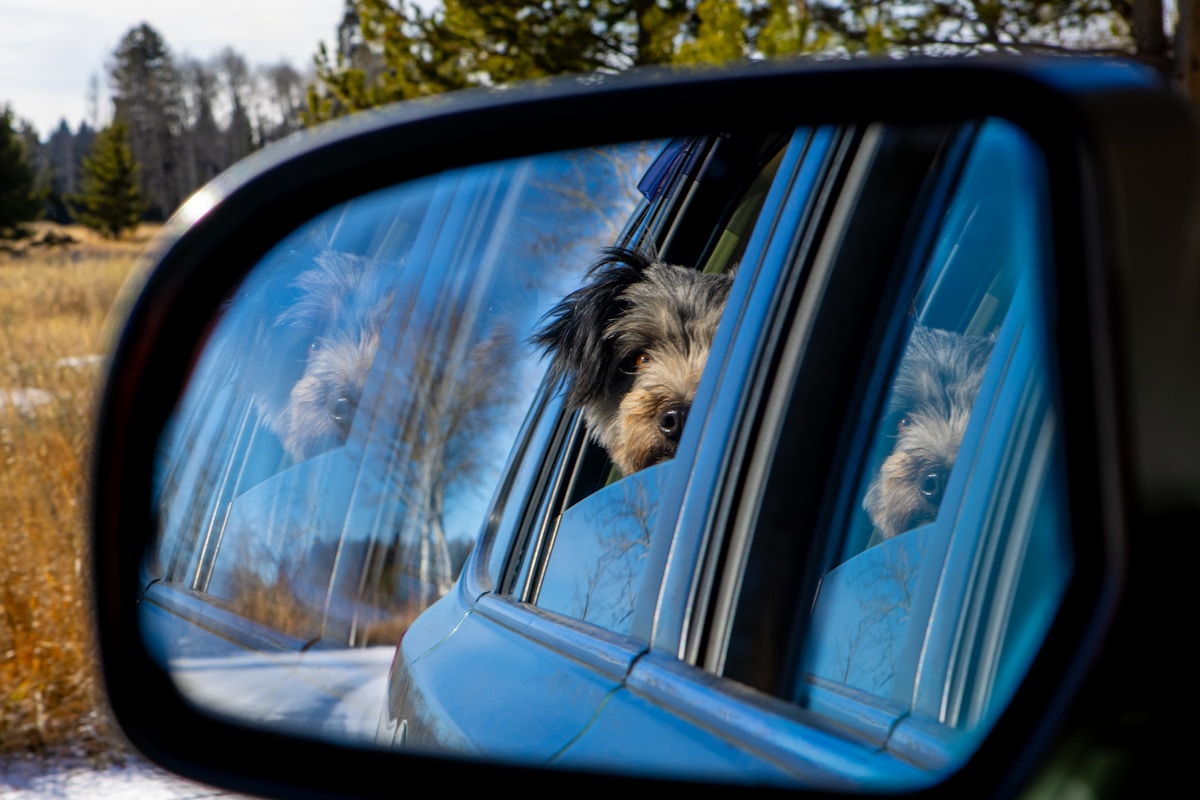
Few domestic encounters are as comical, charming, and philosophically profound as a puppy’s initial encounter with a full-length mirror. An eight-week-old golden retriever pup ambles into a hallway, catches sight of its reflection in a bedroom mirror, and skids to a sudden halt. Its ears perk forward, its spine arches into an exaggerated play-bow, and it lets out a sharp, high-pitched puppy bark. It takes two bouncy steps forward, ducks behind the edge of the glass expecting to find a playmate hiding in the adjacent wall, and looks visibly bewildered when no physical animal exists in the three-dimensional space.
Within a few days or weeks, however, that same puppy’s reaction undergoes a complete transformation. It walks past the identical mirror, glances casually at the glass, and strolls past without a second glance. It does not bark, it does not play-bow, and it does not search behind the frame. If you hold a mirror directly in front of an adult canine, the dog will almost invariably look right through the reflection, avert its gaze, or turn its head away as if the mirror were completely empty. Similarly, if you hold up a high-resolution, color photograph of the dog, or display its face on an iPad screen, the dog shows zero interest, ignoring its own portrait entirely.
This striking indifference led early twentieth-century psychologists to conclude that domestic canines possess zero self-awareness: that dogs live in a state of perceptual oblivion, incapable of conceiving of themselves as independent, conscious beings. But is that scientific conclusion fair, or is it a classic example of human visual chauvinism? Drawing upon landmark cognitive research from the Association of Professional Dog Trainers, sensory ethology pioneered by Dr. Marc Bekoff at the University of Colorado, groundbreaking olfactory mirror trials from Dr. Alexandra Horowitz at Barnard College, behavioral archives from the American Kennel Club, and veterinary neurology standards from the American Veterinary Medical Association, this comprehensive guide examines the true science of canine self-recognition, why dogs fail visual tests, and how they triumph in the olfactory mirror.
The Mirror Self-Recognition Test (MSR): Gordon Gallup’s Primate Paradigm
To understand the debate surrounding canine self-awareness, we must first examine the historical gold standard of cognitive self-recognition: the Mirror Self-Recognition (MSR) test, developed in 1970 by American evolutionary psychologist Dr. Gordon Gallup Jr.
1. The Mark Test Methodology
Gallup designed the MSR test to evaluate whether non-human animals possess a concept of the physical self. The experimental protocol is elegant:
- An animal is anesthetized or gently distracted while an odorless, non-tactile spot of bright red dye is applied to an area of its body that it cannot see directly without a mirror: typically the forehead, the eyebrow ridge, or the tip of an ear.
- Once the animal is fully alert, it is placed in a neutral room containing no reflective surfaces to establish a baseline: confirming that the animal does not touch or notice the dye mark.
- Finally, a full-length mirror is unveiled. If the animal looks into the mirror, reaches up, and touches or investigates the red mark on its own physical body (rather than touching the mirror glass), the animal passes the test. This spontaneous self-directed behavior proves that the animal recognizes the reflection as its own body rather than an unfamiliar conspecific.
2. The Exclusive Elite Club of Mirror Masters
Over fifty years of rigorous international testing, only a tiny handful of non-human species have reliably passed Gallup’s visual mark test: chimpanzees, bonobos, orangutans, bottlenose dolphins, Asian elephants, Eurasian magpies, and manta rays. Even gorillas fail frequently due to eye-contact taboos. When domestic dogs are subjected to the standard visual mark test, they fail one hundred percent of the time. A dog with a red dot painted on its forehead will look into the mirror and make zero attempts to touch its own brow.
The Fallacy of Visual Chauvinism: Why Dogs Fail the Visual Mirror
Does failing Gallup’s mirror mark test prove that dogs lack self-awareness? Modern cognitive ethologists argue that applying the visual mirror test to canines is like testing a bat’s intelligence by measuring its ability to read fine print in daylight: it tests the wrong sensory modality.
1. The Limitations of Canine 2D Visual Perception
As explored in canine ophthalmic science, dogs possess a visual acuity of approximately 20/75, lacking fine focal resolution for static, non-moving details. Furthermore, dogs are dichromats who cannot see red; a bright red dye mark on their forehead appears to them as an indistinct, murky brownish smudge that blends into their fur.
Most fundamentally, dogs do not groom their faces using their paws the way primates groom their skin with nimble, opposable fingers. Primates are visually obsessed groomers who inspect their own skin, pick off parasites, and examine their facial appearance daily. Canines do not have hands, do not pick parasites off their own brows, and have zero evolutionary reason to care about a colored smudge on their fur.
2. The Acoustic and Olfactory Vacuum of the Mirror
To a dog, an authentic canine conspecific is an intense multi-sensory event. A real dog entering a room produces loud breathing sounds, the clicking of claws on the floor, and above all, a massive olfactory cloud composed of anal gland pheromones, breath volatiles, and skin lipids.
When a puppy looks into a mirror, it sees a visual representation that moves like a dog, but possesses zero scent, zero acoustic footsteps, and zero thermal body heat. In nature, an animal that makes no sound and has no smell does not exist. After several brief exploratory investigations, the canine brain recognizes the reflection as a phantom, an optical illusion with zero physical or biological reality. The dog habituates rapidly and simply ignores the mirror forever, not because it is unintelligent, but because its multi-sensory radar has classified the mirror as an empty visual artifact.
Clinical research conducted by the Cornell University College of Veterinary Medicine demonstrates that biological sensory thresholds and neurological adaptations play a defining role in everyday canine responses.
The Yellow Snow Paradigm: Marc Bekoff’s Pioneer Olfactory Study
Recognizing that canines are olfactory, rather than visual, organisms, cognitive ethologist Dr. Marc Bekoff at the University of Colorado designed an ingenious sensory-appropriate test of canine self-awareness: the Yellow Snow Test.
1. Five Winters of Field Observations
Over five consecutive Colorado winters, Bekoff tracked his companion dog, Jethro, during daily walks in deep snow. Bekoff carefully collected fresh patches of snow saturated with Jethro’s own urine, as well as patches of yellow snow deposited by other unfamiliar male and female dogs, and familiar neighborhood canine friends.
Bekoff moved and relocated these frozen urine marks to diverse locations along Jethro’s walking paths, timing Jethro’s sniffing duration with a precision stopwatch and recording whether Jethro chose to over-mark the snow with his own fresh urine.
2. The Definitive Findings: Self versus Other
The experimental results, published in the journal Behavioural Processes, were unambiguous:
- When Jethro encountered yellow snow containing his own urine, he sniffed it for an average of mere seconds (typically under two to three seconds), showed no signs of excitement, and almost never urinated over his own mark.
- When Jethro encountered yellow snow deposited by other dogs, his sniffing duration quadrupled (averaging ten to fifteen seconds). He showed intense physical alertness, curled his lips, and consistently deposited his own fresh counter-mark over the scent.
Jethro clearly recognized his own chemical signature: not as a generic scent, but specifically as mine. He demonstrated an internal cognitive awareness of the chemical self: understanding that his own scent required no further investigation, while the scent of another individual warranted intense forensic analysis.
The Olfactory Mirror Test: Alexandra Horowitz’s Laboratory Breakthrough
While Bekoff’s Yellow Snow study was a brilliant naturalistic breakthrough, mainstream comparative psychologists demanded controlled laboratory conditions matching the rigor of Gallup’s primate mirror test. In 2017, Dr. Alexandra Horowitz at Barnard College published her landmark study: Smelling Themselves: Dogs Investigate Their Own Odours Longer When Modified in an Olfactory Mirror Test.
1. Creating the Olfactory Mark
Horowitz translated Gallup’s red dye mark directly into the olfactory domain. Thirty-six domestic pet dogs were tested in a controlled laboratory environment using specialized scent canisters containing five distinct olfactory stimuli:
- Canister 1 (The Self): The subject dog’s own clean, unmodified urine.
- Canister 2 (The Other): Urine from an unfamiliar dog.
- Canister 3 (The Olfactory Mark): The subject dog’s own urine modified with an added chemical contaminant: an olfactory mark (a drop of bitter oil or tissue cell suspension).
- Canister 4 (The Controlled Contaminant): The chemical contaminant alone on neutral substrate.
- Canister 5 (The Modified Other): An unfamiliar dog’s urine modified with the identical contaminant.
2. Triumphant Self-Recognition in the Scent Domain
The behavioral results were extraordinary and statistically overwhelming. Just as a human or chimpanzee in front of a visual mirror glances casually at their familiar face but pauses to scrutinize an unexpected red mark on their brow, the tested dogs displayed precisely the identical cognitive reaction in the olfactory domain.
The dogs spent significantly longer sniffing Canister 3 (their own urine with the added mark) than they did sniffing their own clean urine (Canister 1) or the contaminant alone (Canister 4). The dogs recognized: This is my own scent, but something about my scent has been altered. This heightened investigation of the modified self-odor demonstrated conclusively that domestic canines possess an internal, highly calibrated mental representation of their own individual scent profile: passing the olfactory equivalent of the mirror self-recognition test with flying colors.
Clinical standards established by the American Animal Hospital Association (AAHA) emphasize the necessity of structured diagnostic evaluations and routine monitoring protocols.
Body Awareness as an Obstacle: The Physical Self in Space
Beyond olfaction, do canines possess an awareness of their own physical body occupying domestic space? In 2021, cognitive researchers at Eotvos Lorand University in Budapest designed a brilliant physical body-awareness test to evaluate whether dogs understand that their own body can act as a physical obstacle.
1. The Blanket and Mat Removal Paradigm
In this study, researchers had dogs stand on a small fabric blanket spread across the floor. Attached to the blanket was a rope or toy that the dog was commanded to pick up with its teeth and hand to its owner. In the control condition, the rope was loose or attached to a separate mat that the dog was not standing on; the dogs picked it up and handed it over effortlessly.
In the experimental condition, the rope was firmly sewn into the very blanket the dog was standing upon. To lift the blanket, the dog had to understand a complex physical reality: My own body weight resting on this blanket is preventing me from lifting it; therefore, I must voluntarily move my body off the blanket before I can lift the object.
2. Demonstrating Physical Self-Agency
The dogs passed the body-as-obstacle task with overwhelming statistical significance. The dogs pulled on the rope, felt the resistance, and within seconds, deliberately stepped their paws off the blanket onto the bare subfloor, turned around, and lifted the now-unburdened blanket to deliver it to their handler.
This elegant experiment demonstrated that dogs possess clear bodily self-awareness: they understand the physical boundaries of their body, recognize their own weight as a force acting upon the environment, and demonstrate genuine physical agency in problem-solving.
Why Dogs Ignore Photographs and Flat Video Screens
Pet guardians frequently wonder why their dog shows zero interest when shown a photograph of its owner, a canine sibling, or itself. Understanding canine sensory neuro-biology explains this complete disinterest.
1. The Flat, Odorless Mirage of 2D Photography
A printed photograph or smartphone image is a flat, static two-dimensional representation. It lacks the three essential dimensions that define reality for a domestic dog:
- Zero Olfactory Signature: A photograph smells exclusively of printer ink, gloss coatings, or smartphone glass. To a canine’s chemical sensorium, it is completely devoid of biological identity.
- Absence of Kinetic Motion: Canine vision evolved to track movement. A static photographic portrait lacks the micro-movements, eye blinks, and breathing motions that capture the attention of canine rod photoreceptors.
- Lack of Binocular Stereopsis: A photograph provides no 3D binocular parallax, appearing to canine 20/75 visual acuity as a blurry, flat, uninteresting optical texture.
2. Television and Video Screens: The Refresh Rate Revolution
As discussed in canine optometry, dogs ignore older 60-Hertz televisions because they perceive the screen as a rapidly flickering strobe light. However, when modern high-definition screens running at 120 Hertz or 240 Hertz display moving video of animals paired with realistic audio, dogs will frequently bark, track the moving figures across the room, and look behind the television monitor to locate the physical animal, reacting to the motion and sound while remaining unfooled by static photos.
The Neuro-Cognitive Continuum: Primary versus Tertiary Self-Awareness
To evaluate canine self-recognition with scientific rigor, cognitive neuroscientists dismantle the simplistic binary that an animal either possesses full human-like self-awareness or none at all. Comparative neurobiology models, pioneered by Dr. Gerald Edelman and Dr. Jaak Panksepp, frame self-awareness as a stratified neuro-evolutionary continuum.
1. Primary (Affective) Consciousness and Core Selfhood
At the foundation of the continuum lies primary or affective consciousness, localized within subcortical, ancient brain structures: the periaqueductal gray (PAG), the superior and inferior colliculi, and the limbic system. This core self generates visceral subjective experience: feeling pain, hunger, fear, affection, and playfulness.
Every domestic canine possesses robust, undeniable primary consciousness. A dog does not need a reflective mirror to know when its paw hurts, when its stomach is empty, or when it feels joy during a game of tug. This subcortical selfhood provides an unshakeable sense of bodily ownership and agency, anchoring the animal securely within its physical environment.
2. Secondary (Perceptual) and Tertiary (Reflective) Consciousness
Secondary consciousness involves the ability to form mental representations of objects and events in time, integrating sensory memories with immediate perceptions. This is where canines excel through olfaction: forming rich episodic-like memories of familiar pack members, spatial maps of their territory, and mental representations of their own scent signature.
Tertiary consciousness, by contrast, represents the pinnacle of symbolic, meta-cognitive self-reflection: thinking about thinking, projecting the self into distant pasts and hypothetical futures, and contemplating one’s physical visual appearance. This level of reflective consciousness is largely exclusive to humans, mediated by an massively expanded neocortex. Expecting a dog to care about its reflection in a visual mirror is demanding tertiary symbolic cognition from an animal whose evolutionary perfection lies in acute secondary perceptual mastery.
Comparative Epistemology: The MSR Paradigm Across Diverse Taxa
Examining how other non-human species interact with the Mirror Self-Recognition test illustrates the profound flaws of relying on visual reflection as a universal test of animal cognition.
1. Cetaceans and Elephants: Multi-Sensory Behemoths
Bottlenose dolphins and killer whales pass the visual mirror test by twisting and contorting their bodies to inspect painted dye marks on their bellies and fins. Similarly, Asian elephants pass by using their prehensile trunks to repeatedly touch a white cross painted on their foreheads while gazing into a massive jumbo-sized mirror. Both species are highly social mammals with immense neocortical development and excellent visual acuity, making visual self-inspection ecologically relevant.
2. The Cleaner Wrasse Controversy: Questioning the Gold Standard
In 2019, marine biologist Dr. Masanori Kohda published a groundbreaking study demonstrating that the tiny cleaner wrasse (Labroides dimidiatus), a fish with a brain the size of a grain of rice, reliably passed Gallup’s mark test. When injected with a brown dye mark on its throat resembling a parasite, the fish swam to a mirror, looked at its reflection, dove down to the sandy seabed, scraped its throat against a rock to remove the mark, and swam back to the mirror to inspect whether the mark was gone.
The cleaner wrasse trials ignited fierce debate among cognitive scientists. If a tiny reef fish passes the visual mirror test while dogs, wolves, monkeys, and African gray parrots fail, does the test truly measure high-level reflective self-consciousness, or does it merely test whether an animal possesses the specific motor repertoire (scraping or grooming) and visual attention to remove perceived parasites from its skin? For canines, whose evolutionary survival never relied on visual surface grooming, the mirror test is an evolutionary non-sequitur.
Canine Somatosensory Cortical Mapping: The Proprioceptive Self
How does a dog construct its internal model of physical selfhood? The answer lies within the primary somatosensory cortex (S1) of the canine parietal lobe.
1. The Canine Cortical Homunculus
In mammalian neuroscience, the somatosensory homunculus is a neural map representing the proportion of brain tissue dedicated to processing tactile sensations from specific body parts. In humans, the homunculus features massive hands, lips, and tongue, reflecting our primate dexterity and vocal communication.
In domestic canines, the somatosensory map is dominated by the muzzle, rhinarium (the moist, naked skin of the nose), lips, and vibrissae (whiskers). The canine vibrissae are equipped with specialized mechanoreceptor follicles (sinus hairs) connected to dense clusters of cortical neurons called barrels. Each individual whisker operates as an active, tactile sensor, sweeping the immediate environment to detect spatial boundaries and air currents. A dog’s sense of physical self is felt outward from its muzzle and paws: a tactile and proprioceptive envelope that defines the boundary between my body and the external world.
2. Interoception and Somatic Markers
Canines possess exquisite interoceptive awareness: the ability to perceive internal physiological signals such as heart rate, respiratory effort, digestive fullness, and muscle fatigue. Mediated by the insular cortex, this continuous internal feedback loop provides the dog with continuous somatic confirmation of its living self, operating twenty-four hours a day without requiring an external visual mirror.
The Ontogeny of Selfhood: From Neonatal Reflexes to Adult Autonomy
The development of canine self-awareness unfolds across distinct neuro-developmental stages during puppyhood.
1. The Neonatal Phase (0 to 2 Weeks)
Canine puppies are born altricial: blind, deaf, and unable to regulate their own core body temperature or eliminate waste without maternal stimulation. At this stage, self-awareness is purely rudimentary, governed by brainstem rooting reflexes and tactile thermal seeking. The puppy does not perceive itself as an entity separate from the warm mass of its nursing mother and littermates.
2. Transitional and Socialization Phases (3 to 16 Weeks)
Between three and eight weeks of age, as sensory pathways mature, the puppy begins distinguishing its own body from external objects. Through physical play: wrestling with littermates, experiencing reciprocal bites, and discovering that chewing its own paw produces personal pain while chewing a sibling’s ear elicits a yelp: the puppy maps the physical boundaries of its body. By four to six months of age, as hormonal maturity approaches and scent-marking begins, the adolescent dog establishes a robust, permanent olfactory self-representation, recognizing its own scent signature as mine across every domestic setting.
Neurochemical Correlates of Self and Kin Recognition in Canine Social Packs
The distinction between the self and others is not merely an abstract philosophical inquiry; it is governed by deep neuro-endocrine cascades operating within the canine hypothalamus and pituitary axis.
1. Oxytocin and Arginine Vasopressin Balance
In social mammals, the neuropeptides oxytocin and arginine vasopressin (AVP) regulate the critical cognitive boundary between in-group affiliative bonding and out-group defensive wariness. When a dog detects its own individual scent signature, or that of a deeply bonded human family member or canine pack mate, its brain releases pulses of oxytocin, maintaining baseline emotional equilibrium and dampening sympathetic fight-or-flight reactivity.
Conversely, when an unfamiliar, foreign canine scent mark is encountered, hypothalamic vasopressin circuits activate. Vasopressin increases territorial vigilance, sharpens sensory processing, and primes the motor cortex for territorial defense or cautious exploration. This neurochemical duality demonstrates that canine self-recognition and kin discrimination are fundamental survival mechanisms hardwired into the neuro-endocrine architecture of the species.
2. Endogenous Endorphin Release in Shared Resting Rituals
When canine pack members rest together in mutual physical contact, inter-species tactile stimulation triggers the release of endogenous beta-endorphins. These natural opioid peptides produce a profound sense of shared somatic security. The boundary between the individual self and the social pack becomes fluid: a dog derives personal physical calm and psychological grounding through the shared thermal and olfactory presence of its family.
Horner-Inspired Olfactory Mirror Tests: Evaluating Self-Urine Discrimination Latency
While canines consistently fail the classical visual mirror self-recognition mark test developed for primates, ethologists have demonstrated that dogs possess profound self-awareness centered in the chemical realm. Innovative olfactory mirror experiments demonstrate that dogs spend significantly less time investigating their own urine compared to the urine of unfamiliar conspecifics.
When researchers artificially modify the scent of a dog own urine by adding microscopic chemical tags, the canine inspection latency doubles. This differential olfactory scrutiny confirms that canines maintain a clear internalized cognitive representation of self versus non-self based on chemical scent profiles.
Lack of Contingency Perception: Why Canines Habituate to 2D Optical Reflections
Initial encounters with mirrors often provoke canine play bows, inquisitive barking, or avoidance behaviors as puppies perceive an apparent stranger. However, within a few exposures, dogs habituate completely and begin ignoring their reflection because the 2D optical image lacks essential olfactory and acoustic corroboration.
Because canines do not utilize vision as their primary sensory modality for social identification, an image that emits no scent signatures is rapidly categorized as a non-consequential environmental artifact. This sensory divergence highlights why human visual benchmarks are inappropriate criteria for evaluating canine intelligence.
Somatognosia and Body Awareness: Proprioceptive Spatial Obstacle Navigation
Canine self-awareness extends into robust physical body awareness, termed somatognosia. In specialized body-as-obstacle testing, dogs standing on a small blanket are instructed to pick up the blanket and hand it to a researcher. Test subjects instinctively step off the blanket before attempting to lift it, recognizing their own body mass as the physical obstacle.
This proprioceptive problem-solving demonstrates that dogs understand their physical body position in relation to surrounding objects. Conditioning body awareness through canine parkour, cavaletti rails, and balance disc training enhances physical coordination and mental focus.
Cognitive Evolutionary Divergence: Visual Self-Image versus Chemical Self-Identity
The evolutionary trajectory of canis familiaris prioritized olfactory and auditory acuity over fine visual self-reflection. In the wild, survival depends upon detecting predators and prey across kilometers through airborne scent molecules, making optical self-recognition evolutionary unnecessary.
Appreciating canine self-awareness as an olfactory and sensory construct allows guardians to communicate more effectively with their companions. Tailoring training and enrichment to match a dog sensory reality builds deeper trust and cooperative mutual understanding.
Ethological Self-Perception: Exploring Interspecies Awareness and Spatial Somatognosia
Understanding that canine self-awareness operates primarily through olfactory, acoustic, and proprioceptive modalities rather than visual reflection deepens our appreciation of canine intelligence. When navigating tight physical spaces, negotiating complex agility obstacles, or interacting with family members, dogs continuously calculate their body dimensions and kinetic momentum.
Engaging in balance beam walking, cavaletti rail stepping, and rear-end awareness exercises sharpens somatognosia and builds athletic confidence. Recognizing how your dog perceives its own body in space enhances cooperative training and minimizes injury risks during vigorous outdoor activities.
Fostering a rich sensory environment that stimulates all canine senses ensures complete mental wellness. Respecting the unique sensory architecture of canines allows guardians to forge empathetic, deeply connected relationships grounded in biological reality.
The comparative cognitive evaluation table below analyzes how canines process self-recognition across optical, olfactory, and proprioceptive sensory channels in rigorous scientific trials.
Cognitive Metacognition in Domestic Dogs: Problem-Solving Agency and Self-Agency Awareness
Comparative animal cognition researchers increasingly investigate metacognition in domestic canines, evaluating whether dogs recognize their own knowledge limitations during spatial retrieval tasks. Experimental trials demonstrate that dogs systematically seek human assistance or explore secondary visual angles when an item is hidden beyond their direct perceptual field.
This calculated reliance on communicative cooperation underscores sophisticated self-agency and mental flexibility. Recognizing that dogs possess rich internal subjective experiences transforms how handlers approach cooperative obedience, positive reinforcement, and daily companion interactions.
Diagnostic Comparison Matrix: Cognitive Self-Recognition Across Senses
This table compares how canines and other species process self-recognition across visual, acoustic, and olfactory modalities:
| Sensory Modality | Experimental Paradigm | Canine Performance Result | Primate Performance (Chimps) | Primary Biological Apparatus | Ecological Evolutionary Driver |
|---|---|---|---|---|---|
| Visual Mirror (MSR) | Gallup’s facial red dye mark test | Failed (Zero self-directed grooming) | Passed (Spontaneous touch of brow) | Foveal cone retina vs area centralis | Primate social grooming vs crepuscular hunting |
| Olfactory Mirror (OSR) | Horowitz’s modified urine test | Passed (Investigates altered self-odor) | Untested / Poor olfactory reliance | Olfactory bulb and vomeronasal organ | Chemical territory marking and identity |
| 2D Photographic Image | Static printed face portrait | Failed (Ignored as odorless smudge) | Moderate (Recognizes familiar faces) | Visual cortical facial processing | High-detail visual recognition in apes |
| Dynamic Video Screen | High-refresh 120Hz moving video | Variable (Engages if motion present) | High (Tracks self-motion on screen) | Magnocellular motion visual pathway | Motion tracking in predatory pursuit |
| Acoustic Playback | Recorded vocalizations (whines/barks) | Moderate (Differentiates own voice) | High (Recognizes individual pant-hoots) | Auditory cortex frequency analysis | Vocal pack communication across distance |
| Body As Obstacle (BAO) | Blanket removal body-awareness test | Passed (Steps off blanket to lift it) | Passed (Understands body weight) | Somatic proprioceptive feedback | Spatial navigation and physical agency |
As demonstrated by the comparative metrics above, canine self-awareness is an intricate, multi-modal reality centered in chemical and physical body awareness. The following frequently asked questions clarify common misconceptions regarding dogs and mirrors.
Ethologists conclude that evaluating canine intelligence through visual mirror tests fundamentally misinterprets the species biological reality. When we honor a dog world of chemical, acoustic, and proprioceptive self-awareness, we unlock deeper training potential and build an extraordinary bond of mutual communicative trust.
Frequently Asked Questions (FAQs)
Do dogs know what they look like?
No. Dogs do not possess an internal visual template of their own physical appearance because they live in an olfactory and auditory sensory reality. A dog knows who it is through its unique personal scent signature, its physical body boundaries, and its social relationships, rather than a visual mental image of its face.
Why do puppies bark at mirrors while adult dogs ignore them?
Puppies are naive observers who have not yet learned that visual reflections lack physical reality. When an adult dog encounters a mirror, it has already learned through habituation that the image has no smell, makes no sound, and cannot be touched, categorizing the reflection as an irrelevant optical illusion.
Can a dog recognize its owner in a mirror reflection?
Yes. While dogs ignore their own reflection, many intelligent dogs will use a mirror to monitor their human owners. If an owner stands behind the dog and makes a silent gesture visible only in the mirror, trained dogs will turn around to face the owner, demonstrating that they understand the mirror reflects real physical space behind them.
Did the famous Yellow Snow study prove dogs have self-awareness?
Yes. Dr. Marc Bekoff’s five-year Yellow Snow study proved that dogs distinguish their own scent from the scent of other canines, spending significantly less time sniffing their own urine marks and rarely counter-marking their own deposits, demonstrating chemical self-recognition.
What is the difference between visual self-awareness and olfactory self-awareness?
Visual self-awareness is the ability to recognize one’s physical reflection in a mirror (prominent in visual primates like humans and chimpanzees). Olfactory self-awareness is the ability to recognize one’s individual chemical scent signature and detect modifications to that scent (prominent in macrosmatic animals like dogs).
Why does my dog look behind the mirror when it sees another dog on TV?
Canines understand that physical objects occupy three-dimensional space. When an alert dog sees a realistic moving animal on a television or mirror, its natural instinct is to investigate behind the screen or frame to locate the physical body of the animal it is seeing.
Can dogs recognize their own bark when played back on a recording?
Yes. Auditory playback experiments demonstrate that canines can differentiate their own recorded vocalizations from the vocalizations of unfamiliar dogs, showing lower physiological arousal and fewer alert responses when listening to their own recorded barks.
Do dogs understand that their body takes up physical space?
Yes. The body-as-obstacle experiments conducted at Eotvos Lorand University proved that dogs understand their own body weight and physical presence, deliberately stepping off a blanket when their own weight prevents them from lifting it.
Why does my dog ignore photographs of me when I am away?
A printed photograph or smartphone image is completely odorless and motionless. To a dog whose sensory world is dominated by scent and motion, a flat photograph carries zero emotional or biological relevance, appearing as an odorless, blurry piece of paper.
Can video calls (like FaceTime or Zoom) work for dogs?
Some dogs will react to an owner’s voice playing through a tablet or phone speaker, tilting their heads and wagging their tails. However, they rarely connect the flat 2D image on the screen with their human, responding primarily to the familiar acoustic frequency of the owner’s voice.
The True Nature of the Canine Self
The realization that dogs fail the visual mirror test but master the olfactory mirror is a profound lesson in biological humility. For decades, human science assumed that because dogs did not admire their reflection in glass, they were devoid of self-awareness. In truth, it was our own human vision that was limited: blinded by our primate bias toward sight and mirrors.
A dog’s sense of self does not reside in a piece of silvered glass or a printed photograph. It lives in the rich, fragrant reality of the physical world: in the comforting warmth of its own paws, the familiar scent of its den, the biological certainty of its personal scent mark, and the profound, living bonds it shares with its human family. Dogs know exactly who they are, where they belong, and who they love: not through the illusion of a mirror, but through the deep, authentic sensory reality of life itself.
When we look at our dogs, we are invited to set aside our human-centric assumptions and marvel at a form of consciousness beautifully tuned to the natural world. In every joyful bound, every quiet rest at our feet, and every deep inhalation of the world around them, our canine companions demonstrate a profound, grounded presence that reminds us of the true essence of living.
By learning to honor their unique sensory perspective, we enrich our shared relationship and deepen our appreciation for their remarkable minds. Our dogs do not need a mirror to confirm their place in the world; they live fully, authentically, and joyfully in the present moment, sharing their lives and love with us unconditionally.

Leave a Comment