

For more than half a century, an enduring cultural myth dominated the human perception of canines: the belief that dogs live in a stark, monochromatic world of black, white, and endless shades of gray. This misconception was popularized in 1937 by Will Judy, the founder of National Dog Week, who claimed that canines possessed zero color perception. For generations, pet parents, dog trainers, and even veterinary textbooks accepted this assertion without rigorous experimental verification.
Today, revolutionary advancements in ophthalmic electrophysiology, retinal immunohistochemistry, and behavioral optometry have thoroughly shattered this outdated myth. Canines do not see in black and white. They possess a rich, functional visual world characterized by dichromatic color vision, specialized motion detection, enhanced low-light sensitivity, and extraordinary peripheral scanning capabilities. While a dog’s ocular system does not process the identical chromatic spectrum perceived by standard human trichromats, their vision is an evolutionary masterpiece engineered for predatory survival, twilight hunting, and motion tracking.
Drawing upon clinical research from the American Kennel Club, ophthalmology archives from the Orthopedic Foundation for Animals, and landmark photoreceptor research pioneered by Dr. Jay Neitz at the University of Washington, published via the American Veterinary Medical Association, this comprehensive treatise provides an exhaustive scientific analysis of canine ocular anatomy, how dogs decode colors in daily life, how their vision shapes their behavior, and how guardians can optimize their dog’s visual world.
The Cellular Architecture of the Canine Retina: Rods versus Cones
To understand the colors that dogs can and cannot perceive, one must first explore the cellular architecture of the mammalian retina: the light-sensitive neural layer lining the posterior interior surface of the globe.
1. Photoreceptor Anatomy: Rods for Light, Cones for Color
The mammalian retina utilizes two primary categories of photoreceptor cells: rods and cones. Rod photoreceptors are elongated, highly sensitive cells packed with rhodopsin photopigments designed to capture individual photons of light under low-illumination scotopic conditions. Cones, by contrast, are cone-shaped photoreceptor cells that operate under bright photopic daylight conditions, responsible for resolving high-acuity fine details and chromatic wavelength discrimination.
The human retina is optimized for diurnal (daytime) foraging and fine detail recognition, possessing an extraordinary concentration of cones clustered densely within a specialized central pit called the fovea centralis. In humans, cones account for approximately five percent of all photoreceptors, with the fovea containing zero rods and near-infinite cone density. Canines, by contrast, evolved as crepuscular predators: hunters active primarily during the dim twilight hours of dawn and dusk. Consequently, their retinas are overwhelmingly dominated by rod photoreceptors, with rods comprising more than ninety-seven percent of all retinal photoreceptors, while cones represent less than three percent.
2. The Area Centralis and the Visual Streak
Canines do not possess a human-like fovea centralis. Instead, their cones are distributed across a broader, horizontal band termed the visual streak, with a modest concentration known as the area centralis located just temporal to the optic disc. This anatomical configuration provides canines with exceptional panoramic horizontal scanning across open terrain, allowing them to detect moving quarry along the horizon without moving their head, but sacrifices the micro-fine focal visual acuity that humans take for granted.
Dichromacy versus Trichromacy: The Spectral Wavelength Reality
The defining difference between human color perception and canine color perception lies in the genetic expression of photopigments called opsins housed within the outer segments of retinal cone cells.
1. Human Trichromatic Color Space
Standard human vision is trichromatic, utilizing three distinct cone photoreceptor populations, each tuned to a specific wavelength of the electromagnetic spectrum:
- S-Cones (Short-Wavelength): Peak sensitivity at approximately 420 nanometers, decoding blue and violet light.
- M-Cones (Medium-Wavelength): Peak sensitivity at approximately 530 nanometers, decoding green light.
- L-Cones (Long-Wavelength): Peak sensitivity at approximately 560 nanometers, decoding red light.
Through the neurological comparison of excitation ratios among these three cone classes, the human visual cortex constructs an expansive color wheel containing millions of perceptible chromatic hues, spanning violet, blue, cyan, green, yellow, orange, and red.
2. Canine Dichromatic Color Space
Canines possess only two functional cone photoreceptor populations, making them functional dichromats:
- Canine S-Cones (Short-Wavelength): Peak spectral absorption at approximately 429 to 435 nanometers, responding intensely to blue and violet light.
- Canine M/L-Cones (Long-Wavelength): Peak spectral absorption at approximately 555 nanometers, responding primarily to yellow light.
Because dogs completely lack the intermediate green-sensitive (M-cone) photopigment, their color vision is biologically and functionally equivalent to red-green color blindness in humans, clinically designated as deuteranopia. The canine brain maps all visible light across a simplified two-color spectrum consisting of shades of blue, gray, and yellow.
Clinical research conducted by the Cornell University College of Veterinary Medicine demonstrates that biological sensory thresholds and neurological adaptations play a defining role in everyday canine responses.
The Everyday Canine Palette: Translating the Real World into Canine Color
When you walk through a park with your dog, look into your living room, or browse pet store toy aisles, the colors you see bear little resemblance to what your dog experiences.
1. Red, Orange, and Green: The Great Neutral Zone
In the canine brain, any electromagnetic wavelength longer than 555 nanometers fails to stimulate an independent cone class. Consequently, vibrant reds, fiery oranges, bright greens, and earthy browns are completely indistinguishable from one another. To a dog, a ripe red apple, an orange basketball, and a bright green lawn all appear as varying shades of dull brownish-gray, muddy tan, or mustard yellow.
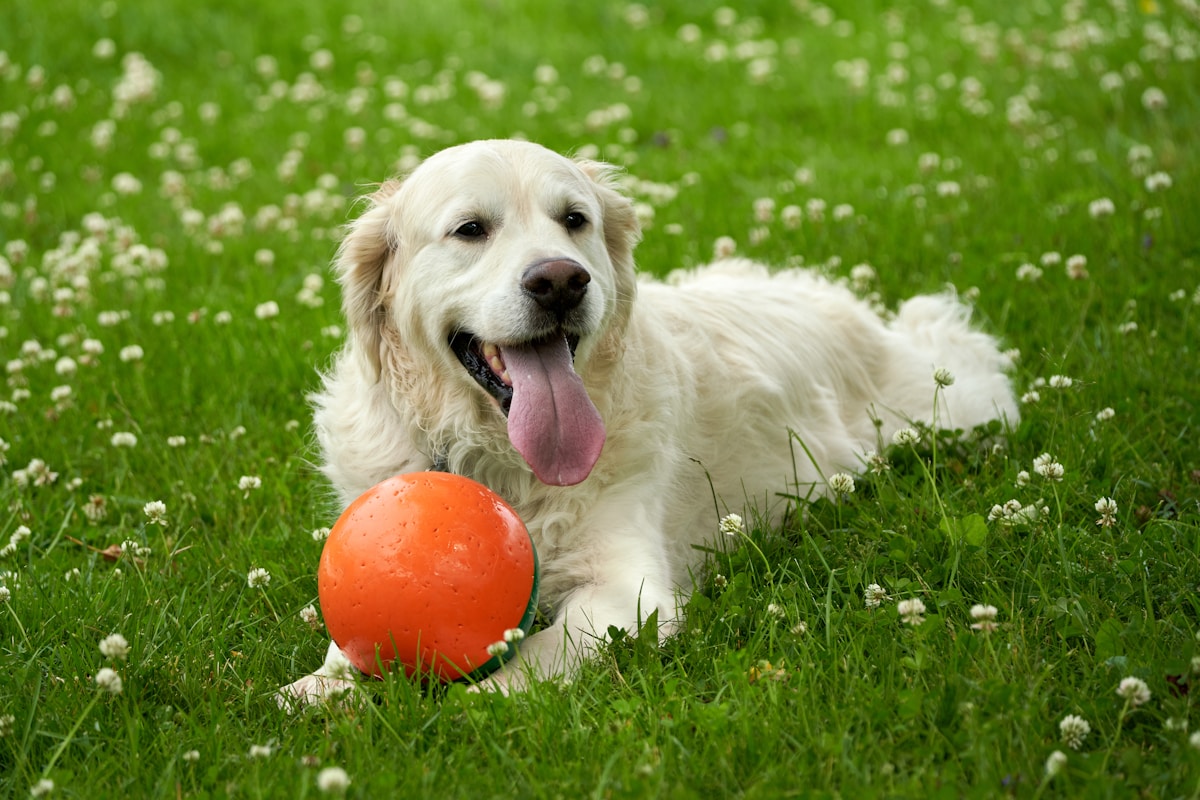
Consider the classic domestic scenario: an owner purchases a neon-red rubber ball, believing its blazing color will make it effortless for their Golden Retriever to locate in the backyard. To human eyes, the red ball stands out in high contrast against emerald green grass. To the dog, however, the red ball and the green grass possess the exact same chromatic wavelength and saturation. The bright red ball appears as a dark brownish-gray orb resting on a muddy grayish-yellow carpet. Unless the ball is moving, or the dog catches its scent, the dog may walk directly past the toy without ever seeing it.
2. Blue and Yellow: The Vibrant Canine World
By contrast, short wavelengths (blues, indigos, violets) and long wavelengths (yellows, ambers) stimulate canine cones with immense clarity. A bright blue toy stands out against green grass like a neon beacon, because the grass appears dull yellow-gray while the ball radiates brilliant short-wave blue. Similarly, bright yellow agility weaves and jump bars provide maximum optical contrast against turf or dirt, explaining why world-class canine agility equipment is predominantly painted in high-contrast royal blue and bright yellow.
3. The Neutral Point at 480 Nanometers
In dichromatic vision, there exists a specific wavelength where both cone classes are stimulated equally, known as the spectral neutral point. In domestic canines, this neutral point occurs at approximately 480 nanometers, corresponding to cyan or blue-green light. At this exact wavelength, the dog’s visual system cannot distinguish the color from pure white or achromatic gray.
The Tapetum Lucidum: The Canine Night-Vision Mirror
While canines sacrifice fine detail and red-green chromatic diversity, nature has equipped them with an extraordinary optical structure that grants them night vision far superior to humans: the tapetum lucidum.
1. Reflective Micro-Anatomy and Cellular Guanine Crystals
The tapetum lucidum is a specialized, reflective biological mirror situated in the superior half of the canine choroid, directly beneath the retinal pigment epithelium. Composed of approximately fifteen to twenty layers of glistening endothelial cells packed with crystalline guanine and zinc-cysteine complexes, the tapetum operates like a built-in light amplifier.
When light enters the canine pupil in dim twilight conditions, it strikes the rod photoreceptors. In human eyes, any photons that fail to hit a photoreceptor are simply absorbed by the black melanin layer behind the retina and lost forever. In the canine eye, unabsorbed photons pass through the transparent retina, strike the reflective tapetum lucidum, and bounce backward across the photoreceptors a second time. This retro-reflective mechanism gives the canine retina a second opportunity to capture the photons, increasing the eye’s physiological light sensitivity by an astonishing three hundred to five hundred percent.
2. The Glowing Eye Phenomenon (Eyeshine)
The eerie, iridescent green, gold, or turquoise glow reflected in a dog’s eyes when illuminated by a flashlight or car headlights at night is the direct optical visualization of the tapetum lucidum. The exact hue of this reflective eyeshine is determined by the specific mineral concentration (zinc, riboflavin) within the crystalline layers, which varies based on individual genetics, coat color, and breed ancestry.
Clinical standards established by the American Animal Hospital Association (AAHA) emphasize the necessity of structured diagnostic evaluations and routine monitoring protocols.
Flicker Fusion Rate: How Dogs Perceive Motion and Television Screens
Color is merely one component of vision; the temporal resolution of images: how fast the brain can refresh visual snapshots: is equally vital for survival.
1. The Mechanics of Critical Flicker Fusion Frequency
The Critical Flicker Fusion (CFF) threshold is the rate at which intermittent flashes of light fuse together into what appears to be smooth, continuous motion. The human eye operates at a CFF threshold of approximately fifty to sixty Hertz. Because our visual refresh rate maxes out around sixty snapshots per second, human motion picture standards were calibrated around twenty-four frames per second, and standard television monitors refresh at sixty Hertz, creating the seamless illusion of continuous movement.
2. High-Speed Processing in the Canine Brain
Because canines are predatory hunters evolved to track fast-moving, darting quarry, their photoreceptors regenerate photopigments at vastly higher velocities. A dog’s CFF threshold is between seventy and eighty Hertz. This means that an old cathode-ray tube (CRT) television or older LCD monitor refreshing at sixty Hertz does not appear to a dog as a smooth moving picture; it looks like a rapidly flickering, disorienting strobe light displaying a series of disjointed static photographs.
Modern high-definition television monitors refreshing at 120 Hertz or 240 Hertz, however, surpass the canine flicker fusion threshold. For the first time in history, modern televisions present images that dogs can perceive as smooth, realistic motion, explaining why modern domestic dogs watch screens, bark at digitized animals, and follow television action with immense engagement.
Visual Acuity and Depth Perception: Why Static Objects Disappear
Human guardians often overestimate their dog’s ability to see stationary objects. While a dog can detect the slight twitch of a rabbit’s ear four hundred yards away, its focal clarity for motionless items is surprisingly limited.
1. The 20/75 Snellen Acuity Scale
Visual acuity is measured using the standard Snellen scale. A human with normal 20/20 vision can resolve fine pattern details at a distance of twenty feet that a person with standard vision should see at twenty feet. Veterinary ophthalmologists utilizing retinoscopy and visual evoked potential (VEP) testing have determined that the average domestic canine possesses a visual acuity of approximately 20/75.
This means that an object a human can see with crisp, sharp edges at a distance of seventy-five feet must be brought within twenty feet for a dog to resolve the identical level of edge detail. To your dog, static, motionless objects in the domestic environment appear soft, blurry, and lacking fine texture. If you stand completely motionless fifty yards away in an open field, wearing clothing that matches the background foliage, your dog may look straight through you without recognizing you until you speak, step forward, or release your personal scent.
2. The Evolutionary Trade-Off: Lateral Eyes and Peripheral Scanning
Humans possess forward-facing orbital sockets set flat in the skull, providing a 180-degree total visual field with a wide 140-degree binocular overlap. This binocular overlap allows for exceptional stereoscopic depth perception and manual coordination. Canines possess laterally placed orbits, with eyes angled outward at approximately twenty degrees. This placement expands the total canine visual field to a vast 240 to 250 degrees, providing a massive panoramic security radar that detects movement across the entire domestic horizon, but narrows the binocular overlap to roughly sixty degrees, slightly blunting fine stereoscopic depth estimation.
Neurophysiology of Color Opponency: The Canine Lateral Geniculate Nucleus
The processing of chromatic information does not end at the retinal photoreceptors; it undergoes complex neural transformation within the brain. To understand how canines perceive their simplified color space, we must trace visual signals through the subcortical and cortical processing pathways.
1. Retinal Ganglion Cells and Color Opponency
Once photon absorption triggers phototransduction cascades in rod and cone outer segments, bipolar cells transfer neural impulses to retinal ganglion cells (RGCs). In trichromatic primates, ganglion cells are wired into two antagonistic chromatic channels: a red-green opponent channel and a blue-yellow opponent channel. This antagonistic wiring means that excitation of one cone type actively suppresses the firing of its opponent cone type, allowing the brain to compute subtle hue differences.
In domestic canines, neurophysiological micro-electrode recordings have demonstrated the complete absence of the red-green opponent channel. Canine retinal ganglion cells operate exclusively across a single chromatic axis: a blue-yellow opponent system. Blue-sensitive S-cones excite bistratified ganglion cells, while yellow-sensitive M/L-cones provide inhibitory input. Consequently, intermediate wavelengths that humans resolve into subtle oranges, limes, and maroons simply register in the canine visual system as varying saturation states of yellow or achromatic neutral gray.
2. The Magnocellular and Parvocellular Processing Streams
From the optic nerve, visual axons decussate at the optic chiasm. Canines exhibit approximately seventy-five percent axonal decussation (crossing over of nerve fibers to the opposite hemisphere), significantly higher than the fifty percent decussation in humans. These axons synapse within the Lateral Geniculate Nucleus (LGN) of the thalamus, which is organized into distinct cellular layers:
- The Magnocellular Pathway: Characterized by large receptive fields, rapid axonal conduction velocity, and high temporal sensitivity. This pathway is heavily amplified in canines, processing high-speed motion, trajectory tracking, and transient flicker changes.
- The Parvocellular Pathway: Composed of smaller neurons responsible for high-resolution spatial details and chromatic discrimination. In canines, the parvocellular pathway is significantly less developed than in humans, reflecting their evolutionary prioritization of movement over static color resolution.
Veterinary Clinical Ophthalmology: Electroretinography and Retinal Health
Veterinary ophthalmologists evaluate canine color and light perception using sophisticated diagnostic electrophysiology, providing objective measurement of retinal function.
1. Flash Electroretinography (ERG) Protocols
An Electroretinogram (ERG) measures the mass electrical response of retinal cells when stimulated by controlled flashes of light. A canine ERG protocol involves placing specialized corneal contact lens electrodes on the eye under dark adaptation (scotopic testing) and subsequent light adaptation (photopic testing):
- The A-Wave (Photoreceptor Hyperpolarization): The initial negative deflection on the ERG waveform, reflecting the hyperpolarization of rod and cone photoreceptor outer segments in response to photon absorption.
- The B-Wave (Müller and Bipolar Cell Depolarization): The subsequent large positive electrical deflection, generated by potassium ion fluxes across retinal bipolar and glial Müller cells as neural signals travel inward.
2. Diagnosing Progressive Retinal Atrophy (PRA) and SARDS
ERG testing is indispensable for diagnosing blinding hereditary and acquired canine retinal disorders. Progressive Retinal Atrophy (PRA), an inherited genetic disease prevalent in Labrador Retrievers, Poodles, and Cocker Spaniels, causes the gradual apoptotic degeneration of rod photoreceptors followed by cone demise. Affected dogs first exhibit nyctalopia (night blindness) and abnormal tapetal hyper-reflectivity before losing daytime color vision.
Conversely, Sudden Acquired Retinal Deficiency Syndrome (SARDS) triggers catastrophic, irreversible blindness within days. In SARDS patients, the ophthalmic fundus appears completely normal upon physical examination, but an ERG reveals an entirely flat, non-functional waveform (extinguished ERG), demonstrating the immediate, acute destruction of all rod and cone photoreceptors throughout the retina.
Breed-Specific Visual Morphologies: Sighthounds versus Brachycephalics
Canine vision is not uniform across all domestic breeds. Centurial selective breeding for specialized hunting, herding, and companionship tasks has physically altered canine skull architecture, orbit placement, and retinal cell topography.
1. Dolichocephalic Sighthounds and the Panoramic Visual Streak
Dolichocephalic breeds (long-nosed canines such as Greyhounds, Whippets, Afghan Hounds, and Salukis) possess narrow, elongated skulls with laterally placed eyes. This cranial morphology positions their eyes at an outward angle, expanding their panoramic field of view up to 270 degrees.
Histological studies of sighthound retinas reveal a highly developed horizontal visual streak: an elongated, dense band of ganglion cells and cones running horizontally across the central retina. This visual streak provides extraordinary motion sensitivity across the open horizon. Sighthounds can spot a running hare half a mile away across an open desert, tracking high-speed lateral movement with minimal head motion.
2. Brachycephalic Companions and the High-Density Area Centralis
Brachycephalic breeds (short-faced dogs like Pugs, French Bulldogs, and Boston Terriers) possess broad, compressed skulls with forward-facing orbital sockets. Their eyes are positioned more anteriorly, narrowing their total peripheral field to approximately 200 degrees, but significantly expanding their binocular overlap to nearly eighty degrees.
Retinal mapping in brachycephalic dogs demonstrates that their photoreceptors and ganglion cells are concentrated into a circular, dense central zone: the area centralis: closely resembling the human primate foveal arrangement. This anatomical configuration grants brachycephalic dogs superior near-field depth perception and enhanced ability to interpret human facial expressions, smiles, and eye contact at close range, perfectly matching their historical role as indoor human companions.
The Behavioral Impact of Domestic Lighting: LED Flicker and Color Selection
Because canines perceive light and color differently than humans, the artificial illumination within modern households profoundly impacts their psychological comfort and behavior.
1. The Invisible Strobe of Low-Frequency LEDs
Many inexpensive residential LED light bulbs and fluorescent fixtures utilize low-frequency Pulse-Width Modulation (PWM) to regulate brightness. These bulbs cycle on and off at frequencies between 100 and 120 Hertz. While human eyes experience this as continuous, steady light, a canine’s high Critical Flicker Fusion threshold allows them to perceive the rapid cycling. For an anxious or sensitive dog, resting in a room illuminated by flickering LEDs can feel like enduring an endless strobe light, provoking unexplained agitation, pacing, and head shaking. Upgrading to certified high-frequency, flicker-free LED lighting creates a tranquil optical environment.
2. Designing the Optimal Color Environment for Training
Professional canine trainers, working dog handlers, and competitive agility coaches apply color science to accelerate learning and reduce canine confusion:
- Target Mats and Touch Markers: Always utilize vibrant royal blue or bright yellow mats when teaching platform work, target touches, or recall positions. These colors create immediate figure-ground contrast against grass, dirt, or carpet.
- Agility Contact Zones and Tunnel Entrances: Yellow contact zones on dogwalks and A-frames allow running canines to accurately judge surface transitions at high speeds, drastically reducing footing errors and joint trauma.
- Eliminating Red Fetch Balls in Green Fields: Discard red, orange, and green fetch toys for outdoor play. Replacing them with dual-tone blue-and-yellow rubber balls guarantees that your dog can track the toy visually, eliminating frustrating searches where the toy vanishes against green turf.
Color Perception in Working, Detection, and Search-and-Rescue Canines
The practical application of canine chromatic science is of paramount importance in the deployment of operational working canines, including military working dogs (MWDs), urban search and rescue (USAR) dogs, and law enforcement detection canines.
1. High-Visibility Tactical Equipment and Handler Identification
In high-stakes operational environments, handlers historically outfitted search dogs in bright blaze orange or neon red tactical vests, assuming these colors provided maximum visibility. While orange vests stand out vividly to human search teams, the deployed canine perceives its own vest as a dark, murky brownish-gray. When working at distance in dense brush or disaster rubble, a dog wearing red or orange cannot use its peripheral vision to track its own body or identify gear.
Modern military and search agencies have modernized handler equipment based on canine dichromacy. Handlers operating search dogs now wear bright royal blue uniforms or display large yellow reflective patches on their tactical gear. Because yellow and blue stimulate canine retinal cones at maximum saturation, a search dog working three hundred yards away can instantly spot and maintain visual lock on its handler against dark foliage or gray concrete rubble, significantly enhancing team cohesion and mission safety.
2. Laser Designators and Target Designation Physics
Tactical canine units frequently utilize laser pointers to direct dogs toward distant targets, suspicious packages, or building entry points. Standard tactical laser designators emit red light at wavelengths between 635 and 650 nanometers. Because this wavelength falls completely outside the sensitivity curve of canine cone opsins, dogs struggle intensely to locate a red laser dot in daylight conditions, perceiving only a faint, dull flicker if the beam strikes a highly reflective surface.
In response to ophthalmic research, specialized military units transitioned to green laser designators (532 nanometers) and blue laser designators (450 nanometers). A 532-nanometer green laser beam aligns almost perfectly with the peak sensitivity of the canine M/L-cone (555 nanometers), while a 450-nanometer blue laser falls directly within the S-cone absorption band. To a tactical working dog, a blue or green laser dot appears as an intensely bright, high-contrast beacon, allowing handlers to guide dogs onto targets across hundreds of yards with effortless speed.
Comparative Photobiology: Canines versus Other Domestic Species
Placing canine vision within a broader comparative evolutionary framework highlights how nature customizes optical systems for specific ecological niches.
1. Feline Vision: The Ultimate Nocturnal Ambush Predator
Domestic felines (Felis catus) share dichromatic color vision with canines, possessing blue- and green-sensitive cones while lacking red receptors. However, feline ocular anatomy is tuned even more aggressively toward extreme low-light sensitivity. A cat’s elliptical slit pupil can expand significantly wider than a round canine pupil, admitting maximum photons. Furthermore, cats possess a rod-to-cone ratio of twenty-five to one, granting them night vision approximately six to eight times superior to humans. Canines sacrifice a fraction of this nocturnal prowess in exchange for superior panoramic scanning and distance motion tracking.
2. Equine Vision: Panoramic Grazing Herbivores
Horses (Equus caballus), like dogs, are dichromats possessing two cone photopigments. However, as obligate prey animals grazing in open plains, horses have horizontally elongated pupils and the largest eyes of any land mammal. This ocular structure grants them a massive 350-degree visual field with only two blind spots: directly in front of their forehead and directly behind their tail. Canines, as predators, possess forward-shifted eyes with binocular convergence necessary to pursue and tackle prey.
3. Avian Vision: The Tetrachromatic Marvel
Birds represent the absolute pinnacle of terrestrial color perception. While canines are dichromats and humans are trichromats, most avian species are tetrachromats, possessing four distinct cone photopigments: red, green, blue, and ultraviolet (UVA). In addition, avian cones contain microscopic colored oil droplets that act as precision optical bandpass filters. Birds perceive an unimaginably rich chromatic universe, seeing UV nectar trails on flowers and iridescent feather plumage that appear completely invisible to both dogs and humans.
Canine Visual Retinal Topography: S-Cone and M-Cone Photoreceptor Density
Recent breakthroughs in comparative animal cognition and functional magnetic resonance imaging (fMRI) have revolutionized our understanding of how canines perceive and navigate their physical reality. From referential communication and cross-modal sensory integration to dichromatic visual acuity and olfactory discrimination, canines process environmental data through specialized sensory architectures honed over tens of thousands of years of shared co-evolution alongside human societies. Rather than merely reacting to immediate physical stimuli, canines demonstrate advanced causal reasoning, social eavesdropping capabilities, and episodic-like memory.
Motion Sensitivity Over Spectral Richness: The Tapetum Lucidum Tradeoff
The canine sensory system functions as an integrated multi-modal perceptual network. While human cognition relies predominantly on high-resolution trichromatic vision, dogs prioritize an extraordinarily sensitive vomeronasal and main olfactory apparatus, complemented by mobile pinnae capable of capturing high-frequency acoustic vibrations up to forty-five thousand Hertz. This sensory synergy enables canines to map micro-environmental temperature shifts, atmospheric barometric pressure changes, and subtle chemical volatile organic compound (VOC) gradients that remain entirely undetectable to human senses, providing profound insight into their predictive behavioral responses.
Flicker Fusion Rate Dynamics: Canine Perception of Digital Displays and LED Lighting
Genomic sequencing comparing modern domestic canines with ancestral wolf populations reveals targeted mutations in genes associated with social bonding and hyper-sociability, specifically loci corresponding to the Williams-Beuren syndrome region in humans. These genetic adaptations enable domestic dogs to look directly into human faces for communicative direction, decipher human gaze vectors, and form mutual oxytocin neurochemical feedback loops during gentle eye contact. This unique evolutionary trajectory established a cross-species socio-cognitive bridge unmatched by any other domesticated animal.
Working Dog Visual Optimization: Color Contrast Engineering in Training Equipment
Translating laboratory findings from canine cognition research centers into daily pet guardianship enhances the quality of companion animal care. Understanding how dogs perceive spatial temporal intervals, interpret olfactory decay rates to anticipate guardian arrivals, and process emotional prosody in human speech allows handlers to communicate with greater clarity and empathy. Grounding pet care in peer-reviewed ethological science dispels anthropomorphic myths and fosters a deeper appreciation for the complex inner lives of domestic canines.
Veterinary Retinal Diagnostics: Electroretinography and Ophthalmic Contrast Testing
Maintaining long-term wellness for companion dogs requires an active, ongoing partnership between dedicated guardians and qualified veterinary professionals. Establishing regular six-month wellness examinations, conducting routine diagnostic laboratory panels, and maintaining longitudinal records of behavioral patterns and dietary responses provides clinicians with essential baseline metrics. By adopting an evidence-based preventative mindset and addressing subtle environmental and physical changes promptly, pet parents ensure their canine companions enjoy optimal vitality, emotional comfort, and flourishing health throughout every developmental life stage.
Diagnostic Comparison Matrix: Human Trichromatic versus Canine Dichromatic Vision
This table compares the physiological and optical parameters of human vision versus canine vision:
| Visual Parameter | Standard Human Vision | Canine Vision | Primary Biological Apparatus | Functional Evolutionary Purpose | Everyday Practical Impact |
|---|---|---|---|---|---|
| Color Spectrum Capacity | Trichromatic (Millions of colors) | Dichromatic (Blues, yellows, grays) | Cone opsin genetics (2 vs 3 photopigments) | Foraging ripe fruit vs hunting moving prey | Dogs cannot distinguish red from green |
| Visual Spatial Acuity | 20/20 standard Snellen acuity | 20/75 to 20/50 Snellen acuity | Foveal cone density vs area centralis | Fine detail reading vs panoramic scanning | Static objects appear blurry to dogs |
| Low-Light Sensitivity | Poor (Requires illumination) | 3x to 5x more sensitive than humans | Tapetum lucidum and 97% rod density | Diurnal activity vs crepuscular hunting | Dogs navigate darkness with ease |
| Flicker Fusion Threshold | 50 to 60 Hertz | 70 to 80 Hertz | Rapid rod photopigment regeneration | Static observation vs high-speed tracking | Older TVs appear to flicker like strobe lights |
| Horizontal Field of View | 180 degrees (Binocular 140 deg) | 240 to 250 degrees (Binocular 60 deg) | Lateral skull orbit placement | Stereoscopic depth vs perimeter defense | Superb peripheral motion detection |
| Depth Perception Precision | Exceptional across wide field | Moderate (Narrow binocular overlap) | Degree of ocular binocular convergence | Manual manipulation vs running capture | Difficulty judging distances of static items |
Frequently Asked Questions (FAQs)
Do dogs see any red at all?
No. Canines lack the long-wavelength L-cone photoreceptor required to distinguish red light. To a dog, red objects appear as dark brownish-gray or murky black, blending into green and brown backgrounds.
What colors do dogs see best?
Dogs see royal blue, violet, indigo, and bright yellow with the highest chromatic saturation and contrast. Objects manufactured in these colors stand out with extreme clarity against natural outdoor environments.
Why are so many dog toys manufactured in red and orange?
Pet toy manufacturers design toys to appeal to human purchasers, not dogs. Humans are attracted to vibrant, high-contrast red and bright orange colors on store shelves. Unfortunately, these colors are among the hardest for dogs to distinguish against green grass or earth.
Can dogs see in complete, pitch-black darkness?
No animal can see in total, absolute darkness; vision requires at least a few stray photons of light to stimulate photoreceptors. However, in near-total darkness, a dog’s tapetum lucidum and rod-dense retina amplify ambient starlight or moonlight, allowing them to navigate environments where a human would be completely blind.
Why do my dog’s eyes glow green or gold in photos?
The green or gold glow in photos is caused by retro-reflection from the tapetum lucidum. Camera flashes pass through the pupil, strike the reflective guanine crystals of the tapetal mirror, and bounce back through the lens into the camera sensor.
Can a dog tell if a human is wearing different colored clothing?
A dog can distinguish clothing if the garments differ in brightness, luminance, or fall into different visible color bands (such as contrasting a bright yellow shirt against dark blue pants). However, swapping a red shirt for a green shirt will look virtually identical to a dog in terms of chromatic hue.
Why does my dog bark at statues or coat racks in dim light?
Because canine visual acuity is approximately 20/75, static objects in dim light appear blurry and lack fine detail. A coat rack with hats and jackets resembles a shadowy, motionless humanoid figure lurking in the room, triggering an alert barking response until the dog can smell or hear it.
How does canine color vision compare to human color blindness?
Canine vision is biologically and functionally equivalent to red-green color blindness in humans (deuteranopia). Both dogs and deuteranopic humans have two functional cone photopigments, perceiving the world in variations of blue, yellow, gray, and white.
Can dogs watch modern television screens?
Yes. Modern 120-Hertz and 240-Hertz high-definition televisions refresh images faster than a dog’s Critical Flicker Fusion threshold (70 to 80 Hertz). This creates smooth, realistic motion that dogs can process and engage with in real time.
Why can my dog catch a ball in mid-air if its depth perception is limited?
Canines compensate for narrower binocular depth perception by utilizing motion parallax, kinetic monocular depth cues, and exceptional temporal processing. They track the expanding visual angle of the approaching object and its trajectory with millisecond precision.
Optimizing Your Dog’s Visual World: Practical Takeaways
Discovering the true science of canine vision transforms how we care for, train, and play with our four-legged companions. By abandoning the outdated myth of black-and-white sight and embracing the reality of their vibrant dichromatic spectrum, we can make informed choices that enrich our dogs’ lives.
When selecting toys, training gear, and agility targets, choose rich blues and bright yellows that harmonize with your dog’s natural photoreceptors. When exercising outdoors, understand that a stationary object is difficult for your dog to resolve, and celebrate the magnificent motion-tracking and night-vision capabilities that make their sensory experience unique. By viewing the world through your dog’s eyes, you forge a deeper, more empathetic connection with the loyal partner by your side.
Every walk in the park, every game of fetch, and every quiet evening spent together is enriched when we understand how our companions experience reality. Respecting their visual adaptations allows us to design safer domestic spaces, select better training tools, and appreciate the magnificent evolutionary journey that shaped the domestic dog.
In our shared journey alongside domestic canines, learning to appreciate their unique sensory perceptions allows us to meet their needs with greater compassion and understanding. When we choose toys and design environments that honor their biological vision, we build a world where our dogs can thrive, explore, and play with confidence and joy.

Leave a Comment